For English, see below.
Nederlands
In 2020 plaatste ik mijn eerste taalweetje op Twitter. Kort daarna stuitte ik op het account van Danny Bate, een Britse historisch taalkundige die daar ook taalweetjes plaatste. Waar ik algauw infographics ging toevoegen aan mijn tweets om mijn boodschap te kunnen vertellen, bleef Danny het voor elkaar krijgen om zijn fascinerende feitjes over de herkomst van woorden helder en boeiend over te brengen in één tweet van maximaal 280 tekens. Na een tijdje kwamen we in contact en raakten we digitaal bevriend.
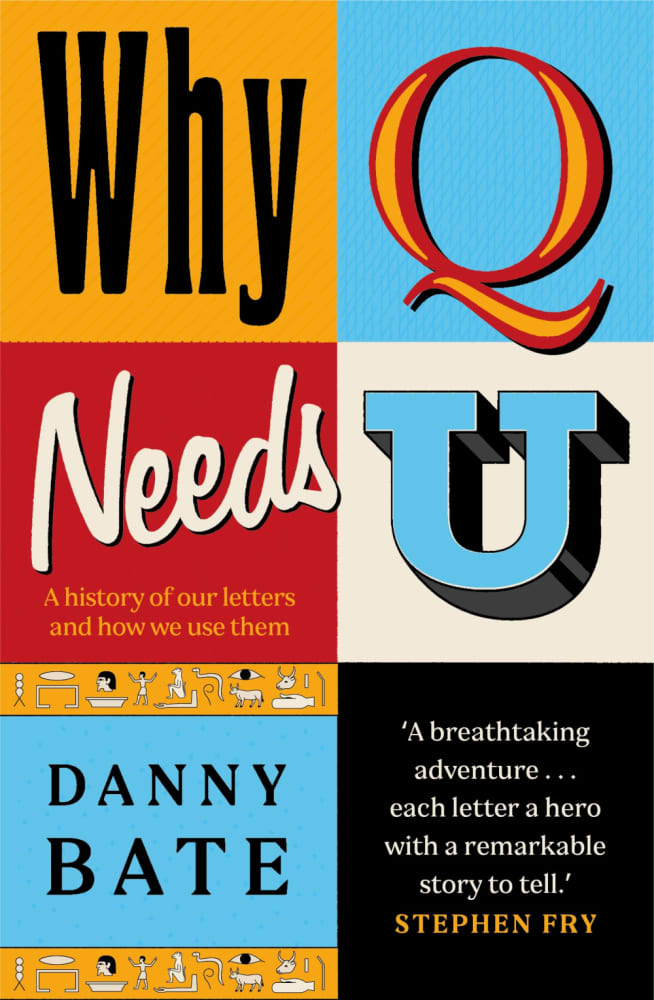
Op 2 oktober 2025 is Danny’s eerste boek uitgekomen: Why Q Needs U: A history of our letters and how we use them. Ik mocht het al lezen voordat het uitkwam. Ik heb enorm genoten van het boek, dus ik besloot een recensie te schrijven. Als je mijn werk interessant vindt, zul je met volle teugen genieten van Why Q Needs U. Scroll naar beneden voor de recensie.
Ik heb de recensie geschreven in het Engels, zodat ik er ook mijn internationale volgers (95%) mee kan bereiken.
English
In 2020, I posted my first language fun fact on Twitter. Shortly after, I stumbled upon the account of Danny Bate, a British historical linguist who also posted language fun facts there. Whereas I soon started adding infographics to my tweets in order to get my message through, Danny managed to convey his fascinating facts about the origins of words clearly and engagingly in one tweet of no more than 280 characters. After a while, we got in touch and became digital friends.
On 2 October 2025, Danny’s first book was published: Why Q Needs U: A history of our letters and how we use them. I got to read it before it was released. I thoroughly enjoyed the book, so I decided to write a review. If you like my work, you’ll absolutely love Why Q Needs U. Scroll down to read the review.
A book I wish for everyone
They’re incredibly rare: people who have a tremendous knowledge and also possess the skill to convey it in a way that’s both accessible and engaging. Danny Bate is one of those people. As a historical linguist, he captivates his followers on the internet with stories about how languages have become what they are. Whether he posts a tweet on a Latin inscription that foreshadowed the new future tense that the Romance languages would develop, creates a video on how the Czech verb koupit (‘to buy’) is related to the English word cheap, or writes an article about historical sound changes that help you make more sense of German, Bate is able to fascinate laypeople and specialists alike. I was thrilled when he announced Why Q needs U: A history of our letters and how we use them – an entire book of linguistic goodness.
Bate had taken on a huge challenge: writing a chapter on each letter of the alphabet to tell the full story of our writing system and how we’ve come to use it. While this approach creates the risk of a forced structure, Bate masterfully managed to make it work to the advantage of the book.
In the first five chapters, he seamlessly intertwines the story of the earliest stages of the alphabet with the individual journeys of A through E. Meanwhile, he provides his readers with a number of basic linguistic concepts that will help them throughout the rest of the book, ranging from the important principle that vowel letters and vowel sounds are very different things, to how languages can be grouped in families, with English being part of the Indo-European language family, just like German, Welsh, Persian and Hindi. After chapter E, you’re ready for all that is to come, while it doesn’t feel like you went through some sort of crash course.
The way Bate dispenses the information is just perfect. The density and the pacing work for readers of all backgrounds. In a friendly tone and always respecting them, he takes his readers by the hand. Questions that may arise are swiftly answered – he knows what’s going on in his readers’ heads. He always stays true to the facts that the science of language provides us with, never stepping into the pitfall of oversimplifying things to make them easier to grasp. Bate just makes sure he explains matters well.
The second part of the subtitle – and how we use them – plays an interesting role. After telling how a letter originated in hieroglyphic writing, made its way through ancient Phoenicia, Greece and Rome, and arrived in the English speaking world, Bate turns to the evolution of the English language itself. In chapter E, for instance, he explains how the Great Vowel Shift that started in the late Middle Ages caused E and O in words such as meet and food to represent sounds that are so different from what these letter stand for in many other languages, such as Dutch, Italian and Czech. In 26 letter chapters, an introduction and an epilogue, he not only tells the story of the letters but also that of the English language.
Dedicating an entire chapter to every one of our letters carries a risk, because several of them have a common origin. For example, you can’t tell the story of U without involving V, but in doing so you might end up stealing V’s thunder. That doesn’t happen in Bate’s book: he skillfully manages to make chapter V at least as interesting as U. For instance, he tells how the Norman Conquest and the subsequent influx of French words boosted the succes of the /v/ sound. He also zooms in on English dialects that have a lot more words starting with V than Standard English because they systematically turned the sound /f/ into /v/ at the beginning of words. It’s these dialects that gave the English word vixen its V instead of the F its male counterpart fox starts with. Nowhere do these approaches feel forced: as a reader you’re only happy that the letter gave Bate the opportunity to share intriguing aspects of the history of English that are connected to this letter.
Why Q Needs U is a book I wish for everyone. With an enthusiasm that jumps off the page, Danny Bate tells you things you didn’t know you always wanted to know. The book is bound to spark your interest if you’re new to linguistics, and if you’re familiar with the field, Why Q Needs U deepens your love for it.
Here’s a link to Danny’s website, where you can find more information, several short reviews and the retail links. (Nederlandse lezers kunnen het boek het beste in Nederland bestellen, zoals hier.)

Danny also makes one of my favourite podcasts, A Language I Love Is..., where he speaks with linguists from around the world about a language they love. If you’d like to know why I love Proto-Germanic, you’ll find out in episode 26.
 Taal aan de wandel
Plaats een reactie